Last Update: 2026-09-30
IEEE 802.11 MAC フレーム解析
IEEE 802.11 MAC フレーム
Wi-Fi 通信で使われる MAC フレームのフォーマットは、IEEE Std 802.11-2020 9.2 節で規定 されている。下図は Protocol Version が 0(PV0)のフレームのフォーマット (Figure 9-2—MAC frame format をもとにして作成した図)で、2.4GHz・5GHz・6GHz 帯の Wi-Fi で送受信されるフレームはすべてこれ。

また、Frame Control フィールドに関しては、Type サブフィールドや Subtype サブフィールドなどを構成要素とすることが定められている。下図は一般的な Frame Control フィールドのフォーマット (Figure 9-3—Frame Control field format in non-S1G PPDUs when Type subfield is not equal to 1 or Subtype subfield is not equal to 6 をもとにして作成した図)で、2.4GHz・5GHz・6GHz 帯の Wi-Fi で送受信されるフレームはすべてこれ。

MAC フレームは、Type サブフィールドの値によって、4 つのタイプに分類される。
- Management
STA と AP の接続や切断などの目的で使用される - Control
フレームの配送を制御するなどの目的で使用される - Data
主に上位層のデータを含むフレーム - Extension
IEEE 802.11ad(WiGig)や IEEE 802.11ah(Wi-Fi HaLow)で使用される
MAC フレームのタイプ・サブタイプ一覧(IEEE Std 802.11-2020 Table 9-1, p.758-760)
| Type value B3 B2 |
Type description | Subtype value B7 B6 B5 B4 |
Subtype description |
|---|---|---|---|
| 00 | Management | 0000 | Association Request |
| 00 | Management | 0001 | Association Response |
| 00 | Management | 0010 | Reassociation Request |
| 00 | Management | 0011 | Reassociation Response |
| 00 | Management | 0100 | Probe Request |
| 00 | Management | 0101 | Probe Response |
| 00 | Management | 0110 | Timing Advertisement |
| 00 | Management | 0111 | Reserved |
| 00 | Management | 1000 | Beacon |
| 00 | Management | 1001 | ATIM |
| 00 | Management | 1010 | Disassociation |
| 00 | Management | 1011 | Authentication |
| 00 | Management | 1100 | Deauthentication |
| 00 | Management | 1101 | Action |
| 00 | Management | 1110 | Action No Ack |
| 00 | Management | 1111 | Reserved |
| 01 | Control | 0000–0010 | Reserved |
| 01 | Control | 0011 | TACK |
| 01 | Control | 0100 | Beamforming Report Poll |
| 01 | Control | 0101 | VHT NDP Announcement |
| 01 | Control | 0110 | Control Frame Extension |
| 01 | Control | 0111 | Control Wrapper |
| 01 | Control | 1000 | Block Ack Request (BlockAckReq) |
| 01 | Control | 1001 | Block Ack (BlockAck) |
| 01 | Control | 1010 | PS-Poll |
| 01 | Control | 1011 | RTS |
| 01 | Control | 1100 | CTS |
| 01 | Control | 1101 | Ack |
| 01 | Control | 1110 | CF-End |
| 01 | Control | 1111 | Reserved |
| 10 | Data | 0000 | Data |
| 10 | Data | 0001 | Reserved |
| 10 | Data | 0010 | Reserved |
| 10 | Data | 0011 | Reserved |
| 10 | Data | 0100 | Null |
| 10 | Data | 0101 | Reserved |
| 10 | Data | 0110 | Reserved |
| 10 | Data | 0111 | Reserved |
| 10 | Data | 1000 | QoS Data |
| 10 | Data | 1001 | QoS Data +CF-Ack |
| 10 | Data | 1010 | QoS Data +CF-Poll |
| 10 | Data | 1011 | QoS Data +CF-Ack +CF-Poll |
| 10 | Data | 1100 | QoS Null |
| 10 | Data | 1101 | Reserved |
| 10 | Data | 1110 | QoS CF-Poll |
| 10 | Data | 1111 | QoS CF-Ack +CF-Poll |
| 11 | Extension | 0000 | DMG Beacon |
| 11 | Extension | 0001 | S1G Beacon |
| 11 | Extension | 0010–1111 | Reserved |
Wi-Fi 6(IEEE 802.11ax)で使われる Trigger フレーム(Type 01、Subtype 0010)は IEEE Std 802.11ax-2021 で追加されてる。
IEEE 802.11 State Machine
IEEE Std 802.11-2020 11.3 節では、Wi-Fi 機器の接続性の関係に基づいた 4 つの状態(State 1 ~ State 4)を規定して いて、これらの状態は IEEE 802.11 State Machine と呼ばれる。下図は、WPA2 や WPA3 のネットワークに 初めて接続する場合を前提に、IEEE Std 802.11-2020 にある図(Figure 11-17—Relationship between state and services between a given pair of nonmesh STAs)を簡略化したもの。
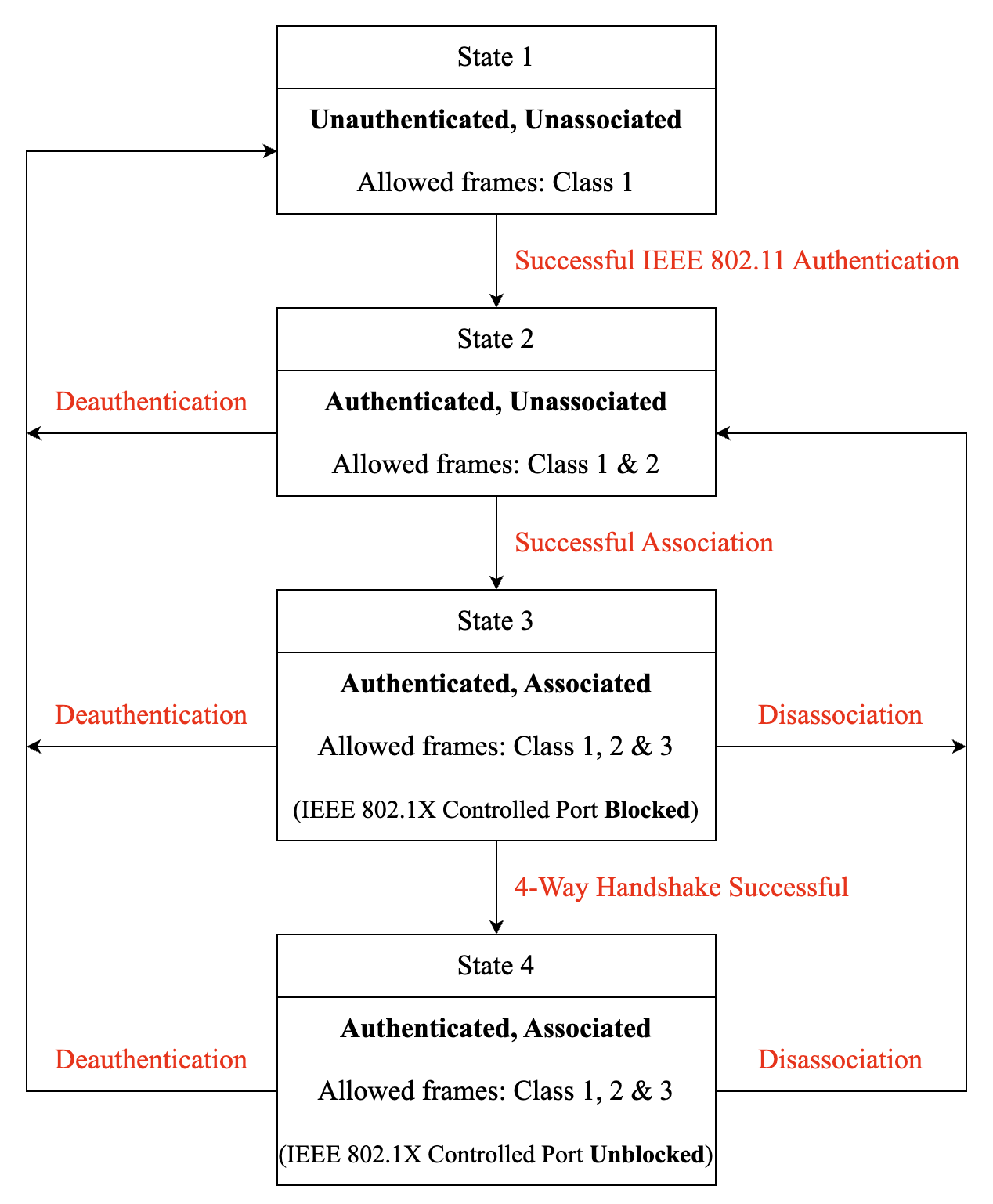
図の Allowed frames の通り、すべての MAC フレームを 3 つのクラス(Class 1 ~ Class 3)に分類していて、各状態で使用できるフレームが制限されている。 各クラスの代表的なフレームは下表の通り(IEEE Std 802.11-2020 11.3.3 節)。
| Class | Management | Control | Data |
|---|---|---|---|
| 1 | Beacon, Probe Request/Response, Authentication, Deauthentication | RTS, CTS, Ack | ― |
| 2 | Association Request/Response, Reassociation Request/Response, Disassociation | ― | ― |
| 3 | Action(ADDBA Request/Response など) | BlockAckReq, BlockAck, PS-Poll | Data, QoS Data |
State 3 と State 4 の違いは、図の IEEE 802.1X Controlled Port が Blocked か Unblocked か。 Controlled Port は、認証が終わるまで一般のデータを通さない。
IEEE 802.1X Controlled Port の役割(IEEE Std 802.11-2020, p.264-265)
The IEEE 802.1X Controlled Port is blocked from passing general data traffic between two STAs until an IEEE 802.1X authentication procedure completes successfully over the IEEE 802.1X Uncontrolled Port. Once the AKM completes successfully, data protection is enabled to prevent unauthorized access, and the IEEE 802.1X Controlled Port unblocks to allow protected data traffic.
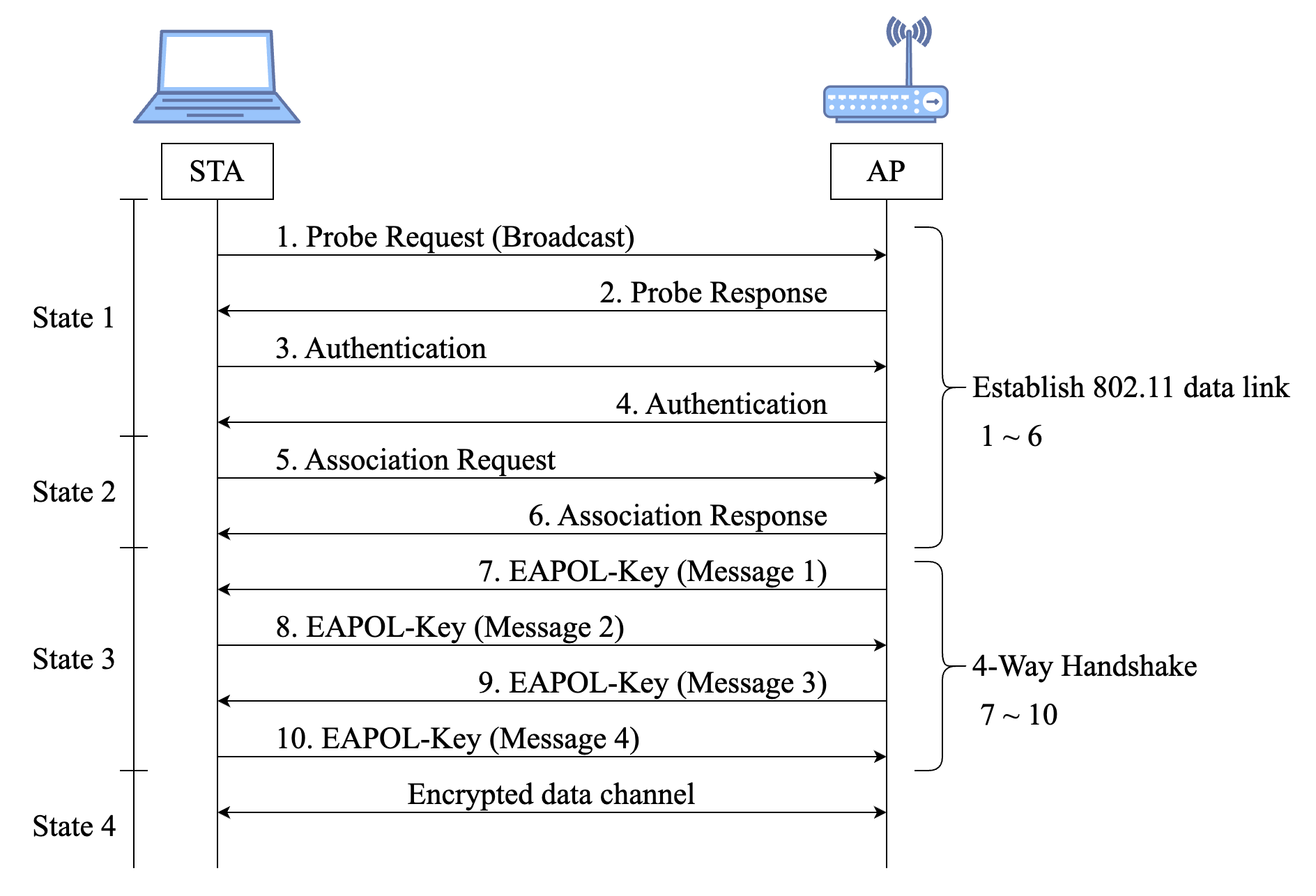
STA と AP は、初期状態(= State 1)から、それぞれの状態で使用できる Management フレームを やり取りしながらデータリンクを確立(= State 3)していく。 その後、4-Way Handshake によって Wi-Fi 通信の暗号化などに使用する鍵を共有し、 Wi-Fi 接続を完了(= State 4)させる。 WPA2-Personal の認証プロセスを例とすると、IEEE 802.11 State Machine の状態遷移の際にやり取り される MAC フレームは下図の通り。
Management フレーム解析
STA が AP に Wi-Fi 接続する際には、接続プロセスの初期フェーズとしてデータリンクが確立される。 データリンク確立の際にやり取りされる Management フレームを見ていく。
解析環境
解析に使用したフレームは、Wi-Fi 6E の WLAN に STA が接続した時のもの。
- 帯域: 6GHz
- SSID:
ishigaki-wlan_cnsa - セキュリティ: WPA3-Enterprise 192-bit mode
- STA: Apple iPad Pro 11 インチ(第 4 世代)
- AP: Aruba AP-615
フレームのキャプチャには MacBook Pro(14 インチ, M3 Pro, Nov 2023)のスニファ機能を使用し、フレームの表示には Wireshark 4.2.6 を使用している。
Beacon
Beacon フレームは、AP から一定の間隔(102.4 ms = 100 TU; 設定可)でブロードキャストで送信され、SSID や対応する機能などを通知する。 STA は、Beacon フレームを受信することでも接続先の AP を見つけられる(パッシブスキャン)。
Beacon の送信タイミング(IEEE Std 802.11-2020, p.2050)
If the AP is a non-S1G AP, it shall define the timing for the entire BSS by transmitting Beacon frames according to dot11BeaconPeriod. … This defines a series of TBTTs exactly dot11BeaconPeriod TUs apart. …
The beacon period is included in Beacon and Probe Response frames, and a STA shall adopt that beacon period when joining the BSS, i.e., the STA sets dot11BeaconPeriod to that beacon period. …
NOTE 2—Though the transmission of a Beacon frame might be delayed because of CSMA deferrals, subsequent Beacon frames are scheduled at the undelayed nominal beacon interval. …
下図は実際に観察できた Beacon フレーム。
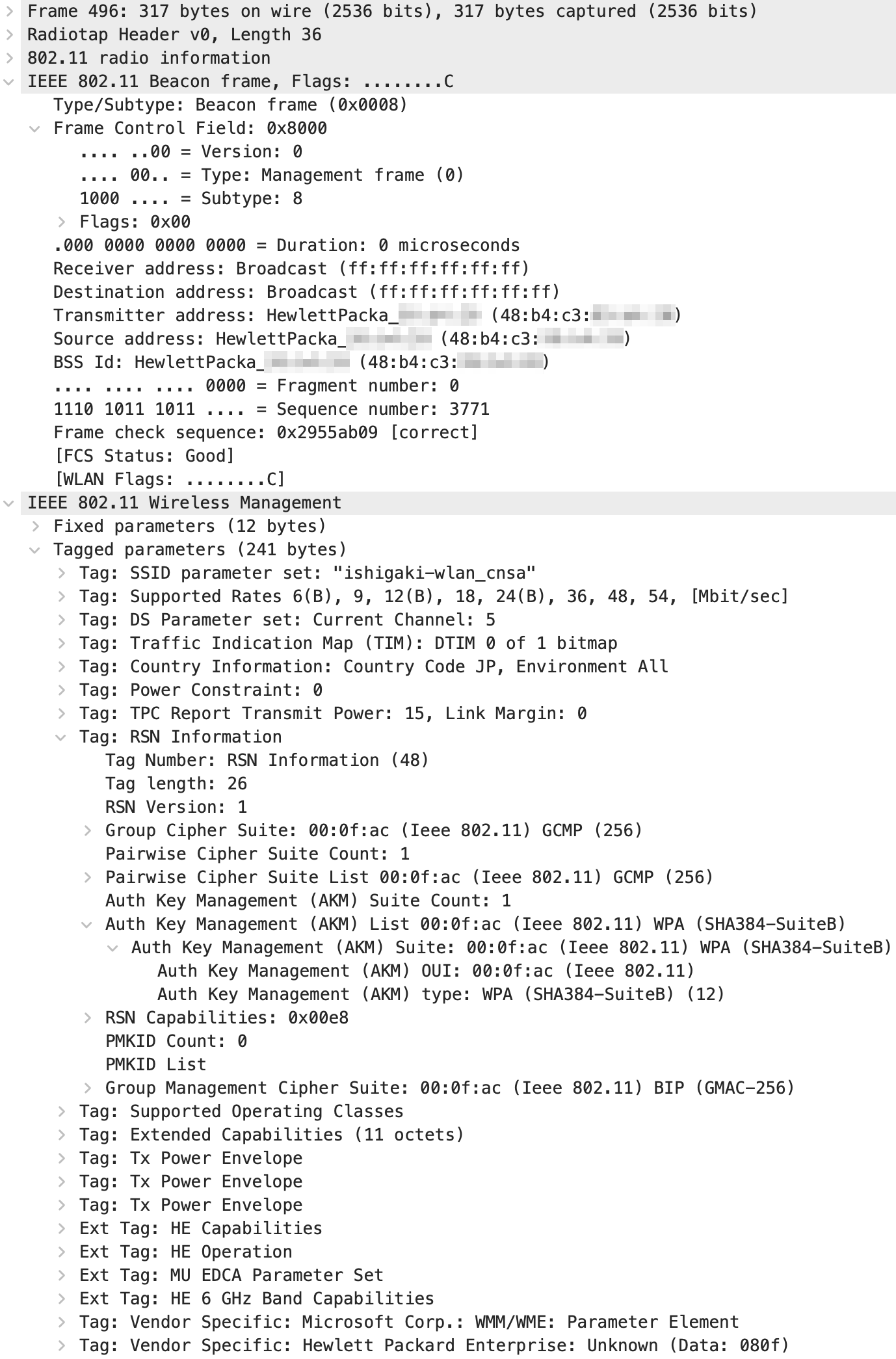
- Receiver address と Destination address がブロードキャストアドレス
- SSID parameter set で、SSID(
ishigaki-wlan_cnsa)を通知している - RSN Information で、AKM 方式(SHA384-SuiteB)と暗号方式(GCMP-256、BIP-GMAC-256)を通知している
フレームボディの構成は IEEE Std 802.11-2020 Table 9-32(p.824-828)の通り(IEEE Std 802.11ax-2021 で追加・修正あり、p.120-122)。
また、STA は Beacon フレームを受信するたびに、その受信電力(Beacon RSSI)を測定している。
Beacon RSSI の測定(IEEE Std 802.11-2020, p.2416)
Upon receiving a Beacon frame, a STA measures the received signal strength of the Beacon frame and may store the result in dot11BeaconRssi. If the Beacon frame is received using multiple receive chains, the Beacon RSSI is averaged in linear domain over all active receive chains. The Beacon RSSI is reported in dBm. …
Probe Request
Probe Request フレームは、AP の情報を収集するために STA からブロードキャストで送信される。
下図は実際に観察できた Probe Request フレーム。
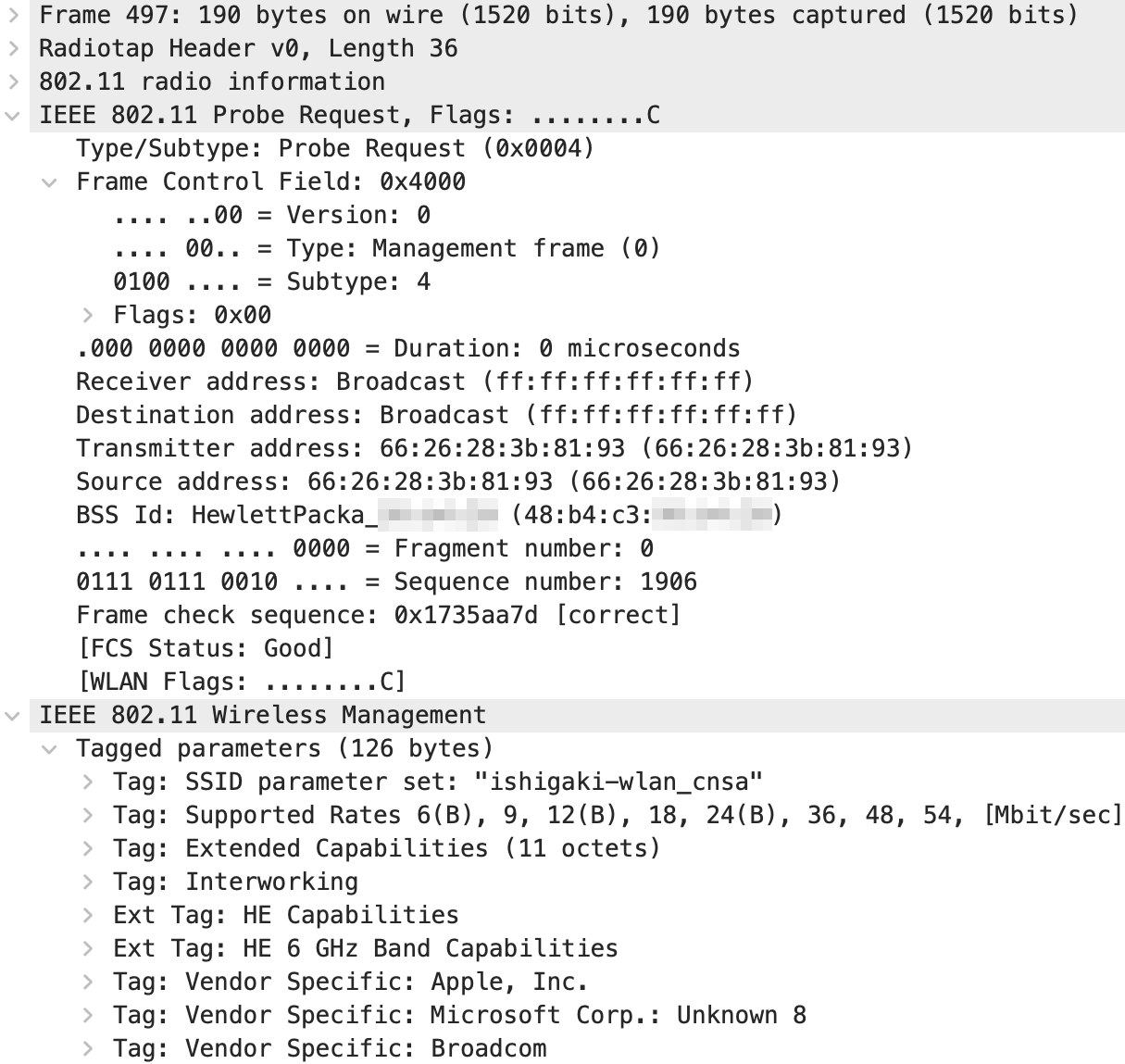
- Destination address にブロードキャストアドレスが指定されている
- SSID エレメントで SSID:
ishigaki-wlan_cnsaが指定されている- このフレームを受信し、指定された SSID をサポートする AP は Probe Response フレームを返さなければならない
- 4 バイトの FCS(Frame Check Sequence)フィールドがある
- FCS フィールドの値は、ヘッダーのすべてのフィールドとフレームボディ全体から計算され、フレームの完全性を検証するために使用される
- フレームの完全性が損なわれていた場合、受信側はそのフレームを破棄する
- 宛先がユニキャストアドレスの場合は、受信側が送信側へ Ack フレームを送信しないため、フレームの再送が発生する
フレームボディの構成は IEEE Std 802.11-2020 Table 9-38(p.842-844)の通り(IEEE Std 802.11ax-2021 で追加・修正あり、p.126)。
Probe Response
Probe Response フレームは、Probe Request フレームに対する応答として AP から STA に送信され、
接続方式や対応規格などの情報を含む。なお、6GHz 帯の WLAN では AP からブロードキャストで送信
される場合もある。
下図は実際に観察できた Probe Response フレーム。
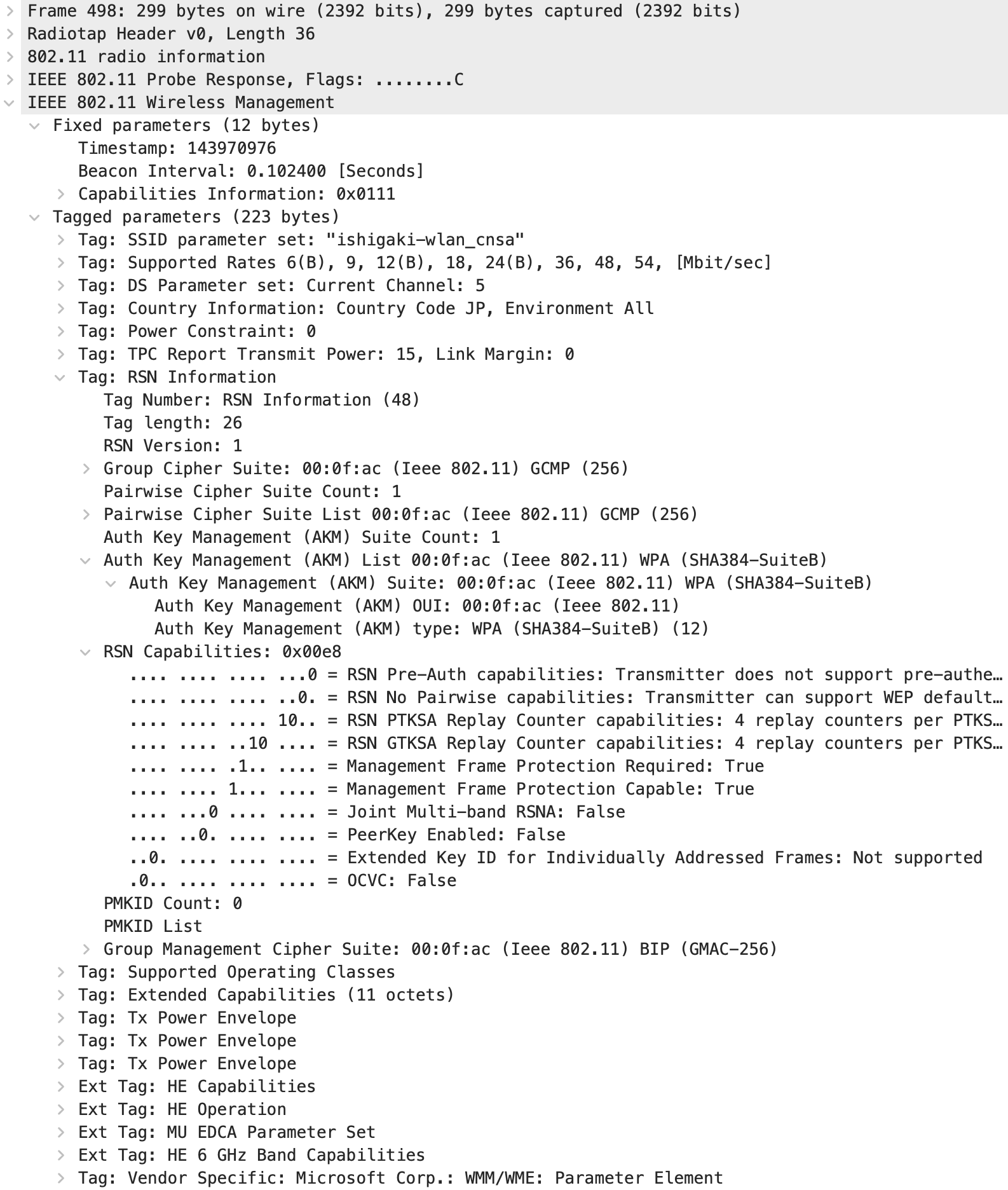
WPA3 Specification で規定されている WPA3-Enterprise 192-bit mode の仕様に適合してる (下記の 2 点)。
- Auth Key Management (AKM) List フィールドで、AKM 方式として SHA384-SuiteB だけが指定されている
- Management Frame Protection Required サブフィールドと Management Frame Protection Capable
サブフィールドがどちらも True になっている
- Protected Management Frames(PMF)が使える、かつ必須
WPA3-Enterprise 192-bit mode の要件(WPA3™ Specification Version 3.3, p.11-12)
When operating in WPA3-Enterprise 192-bit mode:
1. An AP's BSS configuration shall enable AKM suite selector 00-0F-AC:12 (Suite B 192b) and shall not enable any other AKM suite selector. …
3. An AP's BSS configuration shall be PMF Required, i.e., AP sets MFPC to 1 and MFPR to 1 in beacons and probe responses of the BSS. …
フレームボディの構成は IEEE Std 802.11-2020 Table 9-39(p.844-849)の通り(IEEE Std 802.11ax-2021 で追加・修正あり、p.127-128)。
Authentication
Authentication フレームは、STA と AP の IEEE 802.11 authentication を行うために送信される。 IEEE 802.11 authentication は、有線 LAN でいうケーブルの物理的な接続の代わりとなるもので、 AP に接続する場合は、アソシエーションの前に必ず行う必要がある。
IEEE 802.11 authentication の位置づけ(IEEE Std 802.11-2020, p.266)
IEEE 802.11 authentication is used instead of the wired media physical connection.
アソシエーション前の認証(IEEE Std 802.11-2020, p.2447)
In an infrastructure BSS, a non-DMG STA shall complete an IEEE 802.11 authentication exchange prior to association. …
AKM 方式が SHA384-SuiteB(Suite type: 12)の場合、IEEE 802.11 authentication のアルゴリズムは Open System authentication となることが IEEE Std 802.11-2020 Table 9-151 に示されている。
AKM 12 の認証アルゴリズム(IEEE Std 802.11-2020 Table 9-151, p.1055)
Table 9-151—AKM suite selectors(Suite type 12 の行のみ抜粋)
| OUI | Suite type | Authentication type | Key management type | Key derivation type | Authentication algorithm numbers (see 9.4.1.1) |
|---|---|---|---|---|---|
| 00-0F-AC | 12 | Authentication negotiated over IEEE Std 802.1X using a CNSA Suite compliant EAP method | RSNA key management as defined in 12.7 | Defined in 12.7.1.6.2 using SHA-384 | 0 (open) |
IEEE 802.1X を使う方式(WPA2/WPA3-Enterprise)や PSK を使う方式(WPA2-Personal)では、まず Open System authentication を行い、実際の認証はアソシエーションの後(IEEE 802.1X 認証や 4-Way Handshake)で行う。
RSNA で使われる認証(IEEE Std 802.11-2020, p.267)
An RSNA also supports authentication based on IEEE Std 802.1X-2010, or preshared keys (PSKs) after Open System authentication. …
SAE authentication and Open System IEEE 802.11 authentication are used by STAs in an RSN for an infrastructure BSS. …
Open System authentication では実効的な認証は行われず、STA から AP へのフレームがリクエスト、AP から STA へのフレームが認証結果を伴ったレスポンスとなる。
Open System authentication の仕組み(IEEE Std 802.11-2020, p.2448)
Open System authentication is a null authentication algorithm. …
Open System authentication utilizes a two-message authentication transaction sequence. The first message asserts identity and requests authentication. The second message returns the authentication result.
下図は実際に観察できた、STA から AP への Authentication フレーム。
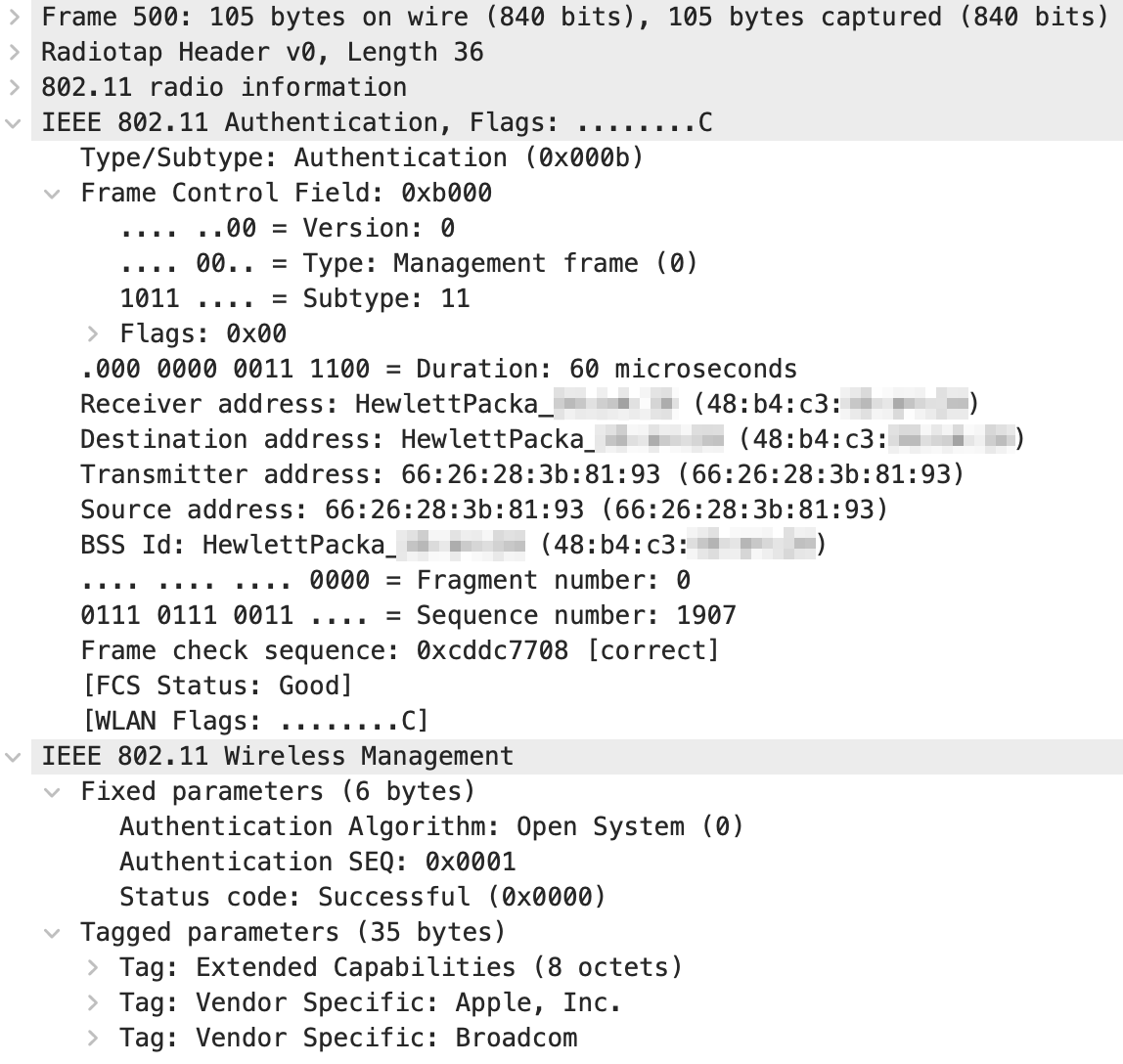
- Authentication Algorithm が Open System になっている
- Authentication SEQ が 1 で、リクエストであることを示している
下図は実際に観察できた、AP から STA への Authentication フレーム。
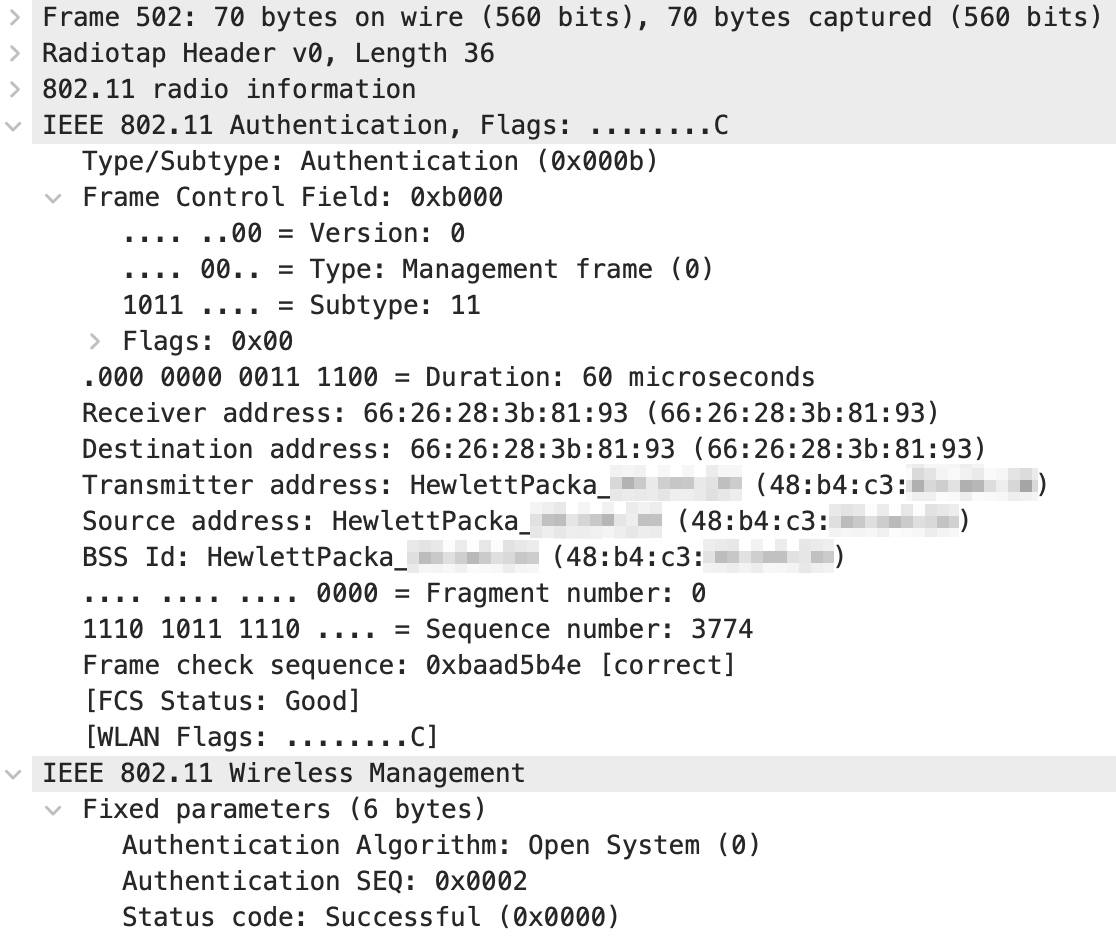
- Authentication SEQ が 2 で、レスポンスであることを示している
- Status code が Successful になっている
- このレスポンスを STA が受信できれば、STA と AP の接続性の関係は State 2 となる
フレームボディの構成は IEEE Std 802.11-2020 Table 9-40(p.850-851)の通り(IEEE Std 802.11ax-2021 での変更なし)。
WPA3-Personal の場合(SAE)
WPA3-Personal では、Open System authentication の代わりに SAE(Simultaneous Authentication of Equals)を使う。 Open System authentication とは違って、SAE では Authentication フレームのやり取りの中で、 STA と AP が同じパスワードを知っていることを互いに確かめる(= 本当に認証している)。
SAE による認証(IEEE Std 802.11-2020, p.267)
SAE authentication uses finite field cryptography to prove knowledge of a shared password.
Association Request
Association Request フレームは、STA が AP に対して、対応するデータレートや接続する SSID やその他 の仕様などを通知して、データリンクの確立を要求するために送信される。 アソシエーションは必ず STA 側から始めるもので、STA が同時にアソシエーションできる AP は 1 台だけ (AP は同時に複数の STA とアソシエーションできる)。
アソシエーションの基本ルール(IEEE Std 802.11-2020, p.265)
At any given instant, a STA is associated with no more than one AP. … Association is always initiated by the non-AP STA, not the AP.
An AP might be associated with many STAs at the same time.
下図は実際に観察できた Association Request フレーム。
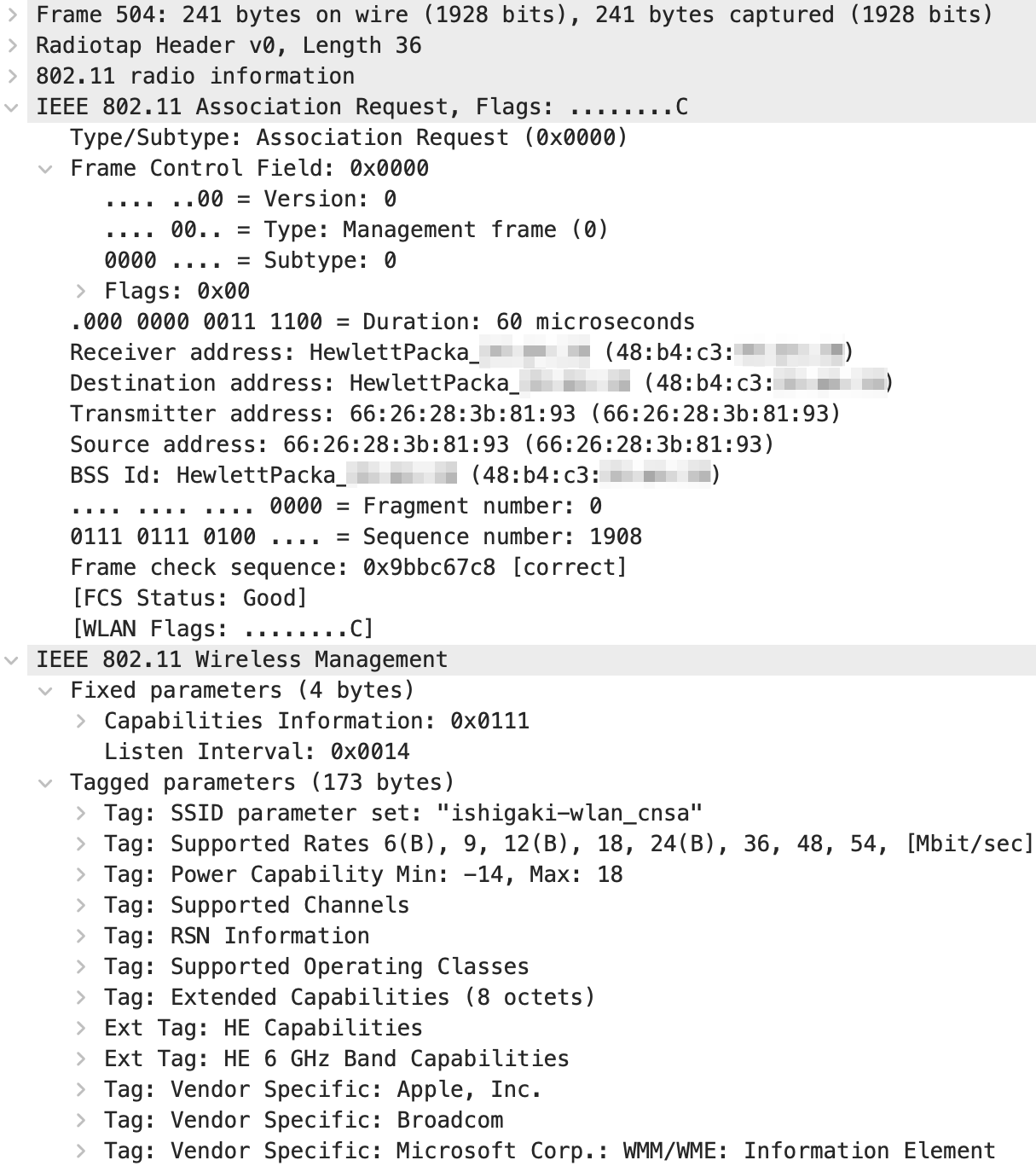
- SSID parameter set で、接続する SSID(
ishigaki-wlan_cnsa)を通知している - Supported Rates で、対応するデータレートを通知している
- HE Capabilities と HE 6 GHz Band Capabilities で、IEEE 802.11ax(Wi-Fi 6/6E)への対応を通知している
フレームボディの構成は IEEE Std 802.11-2020 Table 9-34(p.829-831)の通り(IEEE Std 802.11ax-2021 で追加・修正あり、p.122)。
Association Response
Association Response フレームは、Association Request フレームに対する応答として AP から STA へ
送信される。
下図は実際に観察できた Association Response フレーム。
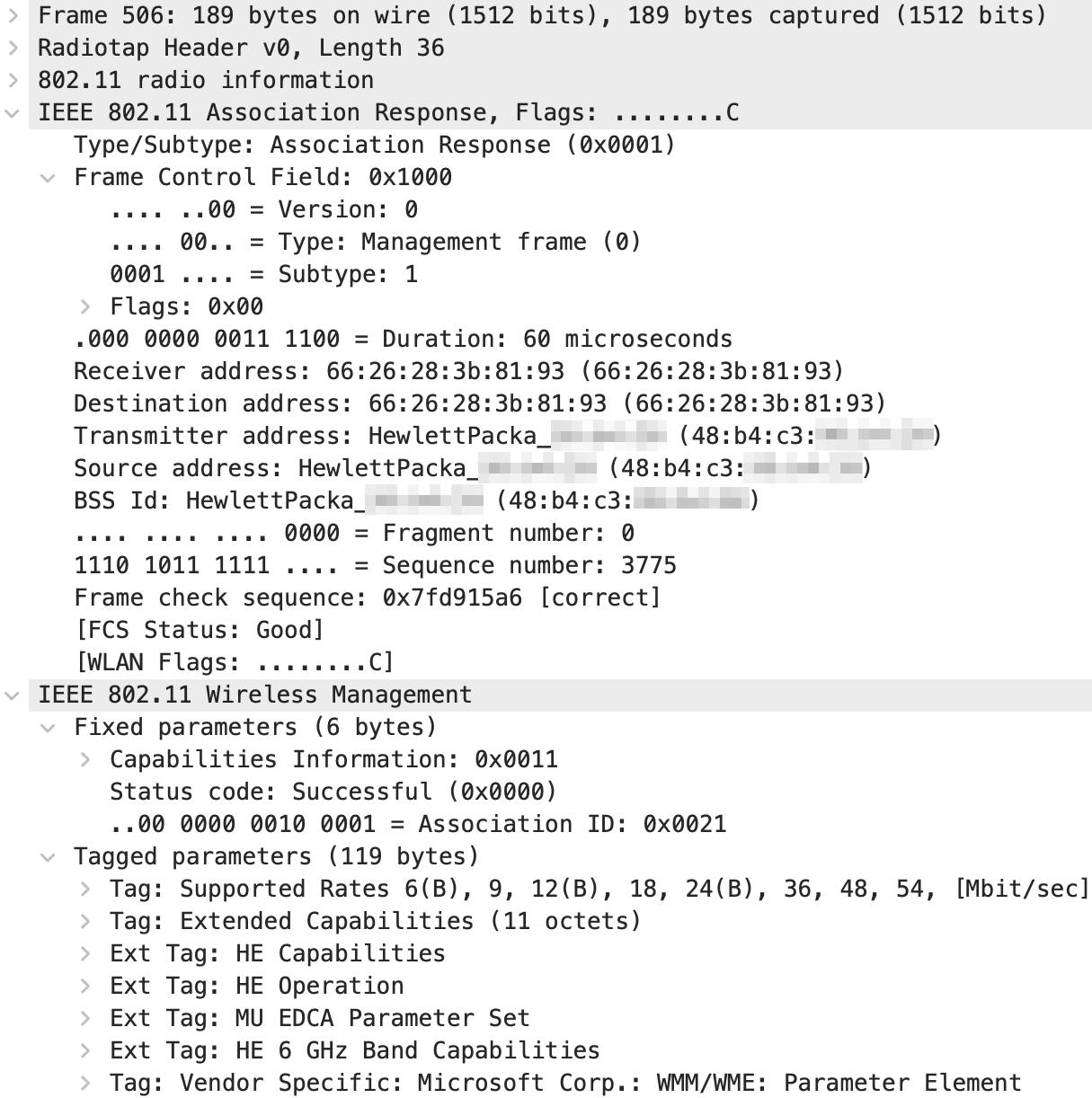
- Status code が Successful になっている
- このレスポンスを STA が受信できたので、STA と AP の間でデータリンクの確立が完了した状態(State 3)となる
- Association ID が 0x0021 になっている
- アソシエーションの際に AP が STA に割り当てた識別子(AID)
フレームボディの構成は IEEE Std 802.11-2020 Table 9-35(p.831-834)の通り(IEEE Std 802.11ax-2021 で追加・修正あり、p.123-124)。
4-Way Handshake フレーム解析
WPA2 や WPA3 が有効な WLAN であれば、データリンクの確立が完了した後、4-Way Handshake が実行 される。認証方式によっては、データリンク確立後に IEEE 802.1X/EAP 認証が必要となる。4-Way Handshake では、STA と AP の間で Data フレームとして EAPOL-Key フレームがやり取りされる。 EAPOL-Key フレームのフォーマットは IEEE Std 802.11-2020 Figure 12-33 に示されている。 STA と AP が PMK を共有できていれば、4-Way Handshake は成功し、Pairwise Transient Key (PTK)・Group Temporal Key(GTK)・Integrity Group Temporal Key(IGTK)などを共有できる。 なお、PTK・GTK・IGTK は Data フレームと一部の Management フレームを保護するために使用される。 ここでは、4-Way Handshake の 4 つのメッセージを見ていく。
Message 1
1 番目のメッセージは AP から STA に送信され、主な目的は ANonce(乱数)を通知すること。
下図は実際に観察できた Message 1。
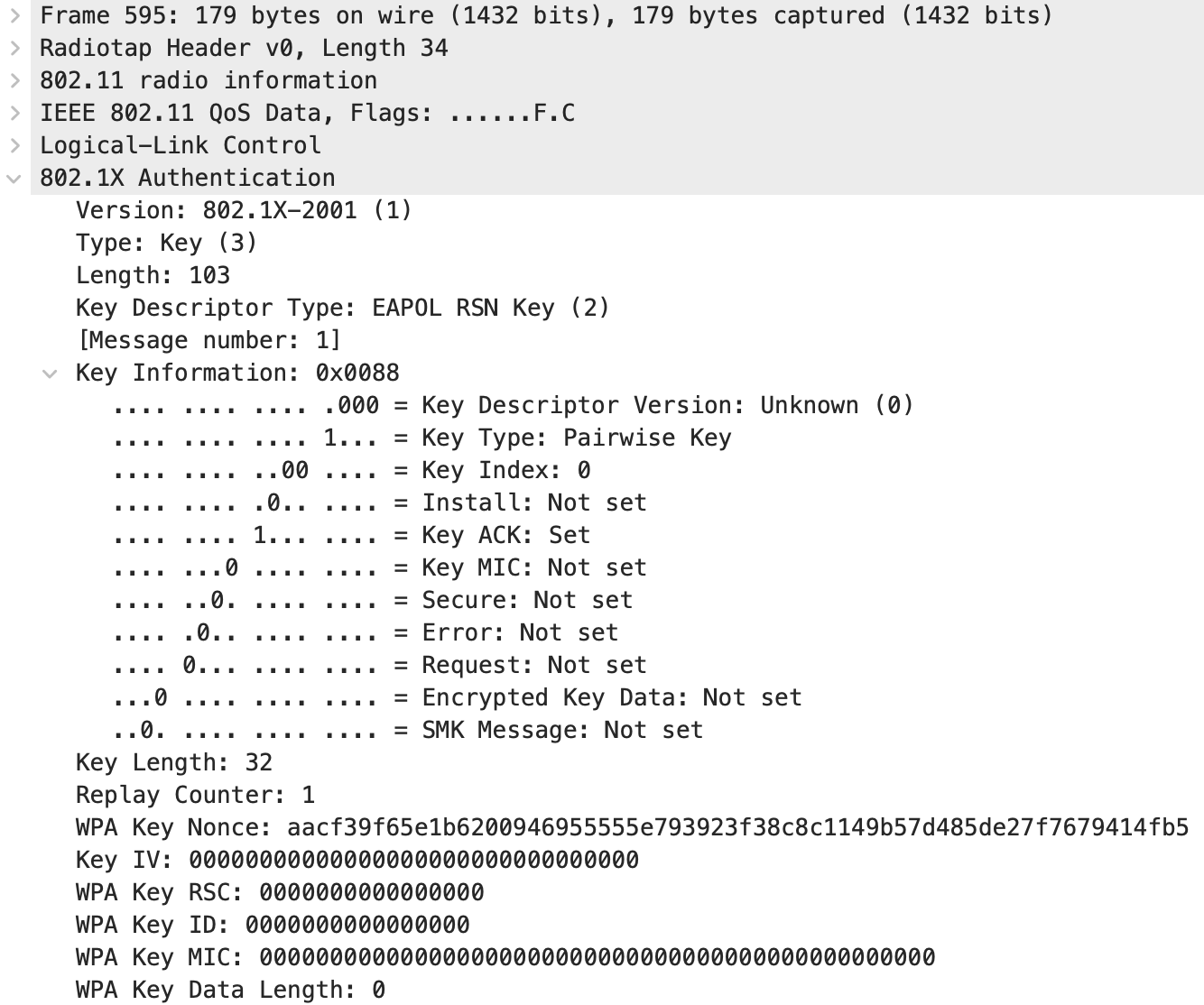
- WPA Key Nonce が 32 バイトの ANonce
- Key Type が Pairwise Key になっている
- この 4-Way Handshake で PTK を作成することを示している
- Key Length が 32 になっている
- PTK に含まれる Temporal Key(TK)の長さが 32 バイトであることを示している
- TK は Data フレームと一部の Management フレームのフレームボディを保護するために使用される(= AP - STA 間のユニキャスト通信を暗号化しているのはこの鍵)
- Key ACK が Set になっている
- このメッセージを受け取った STA には、Replay Counter(ここでは 1)を同じ値にした応答(Message 2)が求められている
- Key Descriptor Version が Unknown (0) になっている
- Wireshark では Unknown と表示されるが、IEEE Std 802.11-2020 12.7.2 では、0 は交渉した AKM(ここでは SHA384-SuiteB)の方式で EAPOL-Key フレームを作成・処理することを示している
- Key MIC が Not set になっている
- 4 つのメッセージの中で MIC を含まないのは Message 1 だけ(IEEE Std 802.11-2020 12.7.6.8)
- Secure が Not set になっている
- AP は、STA が PTK と GTK を持つまでは Secure を 0 にする(Message 3 から 1 になる)
Message 1 の各フィールドの値は、規格で次のように定められている(キャプチャの値と一致している)。
Message 1 の各フィールドの値(IEEE Std 802.11-2020, p.2558)
Message 1 uses the following values for each of the EAPOL-Key frame fields:
…
Key Information:
    Key Descriptor Version = … in all other cases 0
    Key Type = 1 (Pairwise)
    …
    Key Ack = 1
    Key MIC = 0
    Secure = 0
    …
Key Length = Cipher-suite dependent; see Table 12-7
Key Replay Counter = n – to allow Authenticator or initiator STA to match the right message 2 from
    Supplicant or peer STA
Key Nonce = ANonce
…
Message 2
2 番目のメッセージは STA から AP に送信され、主な目的は SNonce(乱数)と MIC(Message Integrity Code)を通知すること。
STA は ANonce を受信した後に PTK を作成し、MIC を計算してこのメッセージで AP へ送信する。
MIC は、WPA Key MIC フィールドの値を 0 としたフレームボディに対して、PTK に含まれる
Key Confirmation Key(KCK)を使って計算される。
下図は実際に観察できた Message 2。
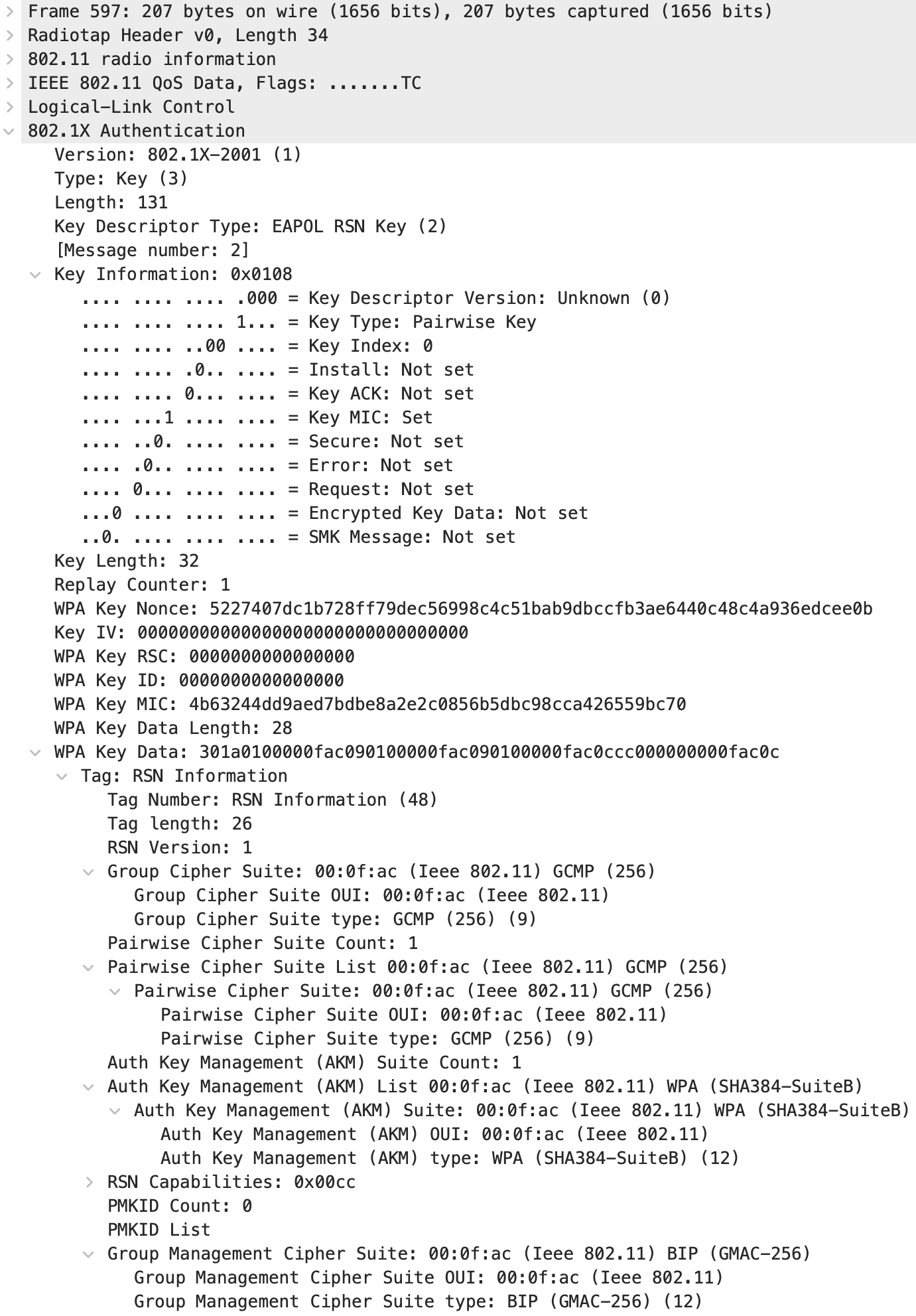
- WPA Key Nonce が 32 バイトの SNonce
- Replay Counter が Message 1 と同じ 1 になっている
- Message 1 に対する応答であることを示している
- WPA Key MIC が 24 バイトになっている
- IEEE Std 802.11-2020 Table 12-10 では、AKM 方式が SHA384-SuiteB の場合、KCK の長さは 192 ビット、MIC サイズは 24 バイトとされているので、適切な MIC サイズで計算されていることが確認できる
- PMK そのものは送らずに、STA が正しい PMK を持っていることを AP に示すための値(= この MIC を AP が検証できれば、両者は同じ PMK を持っている)
- WPA Key Data に含まれる RSN Information で、次の 2 点が確認できる
- Group Cipher Suite と Pairwise Cipher Suite が GCMP-256(= Data フレームの暗号化に使う方式)
- Group Management Cipher Suite が BIP-GMAC-256(= ブロードキャスト・マルチキャストの Management フレームの改ざん検知に使う方式)
- この RSN Information は Association Request フレームで送ったもので、AP はビット単位で一致するかを確かめ、一致しなければ接続を切る(IEEE Std 802.11-2020 12.7.6.3)
- Secure が Not set になっている
- STA はまだ GTK を持っていないため
- Key Length が 32 になっている
- 規格では Message 2 の Key Length は 0 と定められていて(IEEE Std 802.11-2024 でも同じ)、キャプチャの値と異なる
Message 2 の各フィールドの値は、規格で次のように定められている(Key Length 以外はキャプチャの値と一致している)。
Message 2 の各フィールドの値(IEEE Std 802.11-2020, p.2559)
Message 2 uses the following values for each of the EAPOL-Key frame fields:
…
Key Information:
    …
    Key Type = 1 (Pairwise) – same as message 1
    …
    Key Ack = 0
    Key MIC = 0 when using an AEAD cipher or 1 otherwise
    Secure = 0 – same as message 1
    …
Key Length = 0
Key Replay Counter = n – to let the Authenticator or initiator STA know to which message 1 this
    corresponds
Key Nonce = SNonce
…
Key MIC = Not present when using an AEAD cipher; otherwise, MIC(KCK, EAPOL) – MIC
    computed over the body of this EAPOL-Key frame with the Key MIC field first initialized to 0
…
AP はこのメッセージにある SNonce を受信した後、PTK を作成して MIC の検証を行う。もし STA と AP で同じ PMK を共有できて いなかった場合は、この時点で MIC の検証に失敗するため、AP はこの 2 番目のメッセージを破棄する。
Message 3
3 番目のメッセージは AP から STA に送信され、主な目的は GTK や IGTK を配送することと、MIC を通知すること。
GTK や IGTK は WPA Key Data フィールドに格納される。
下図は実際に観察できた Message 3。
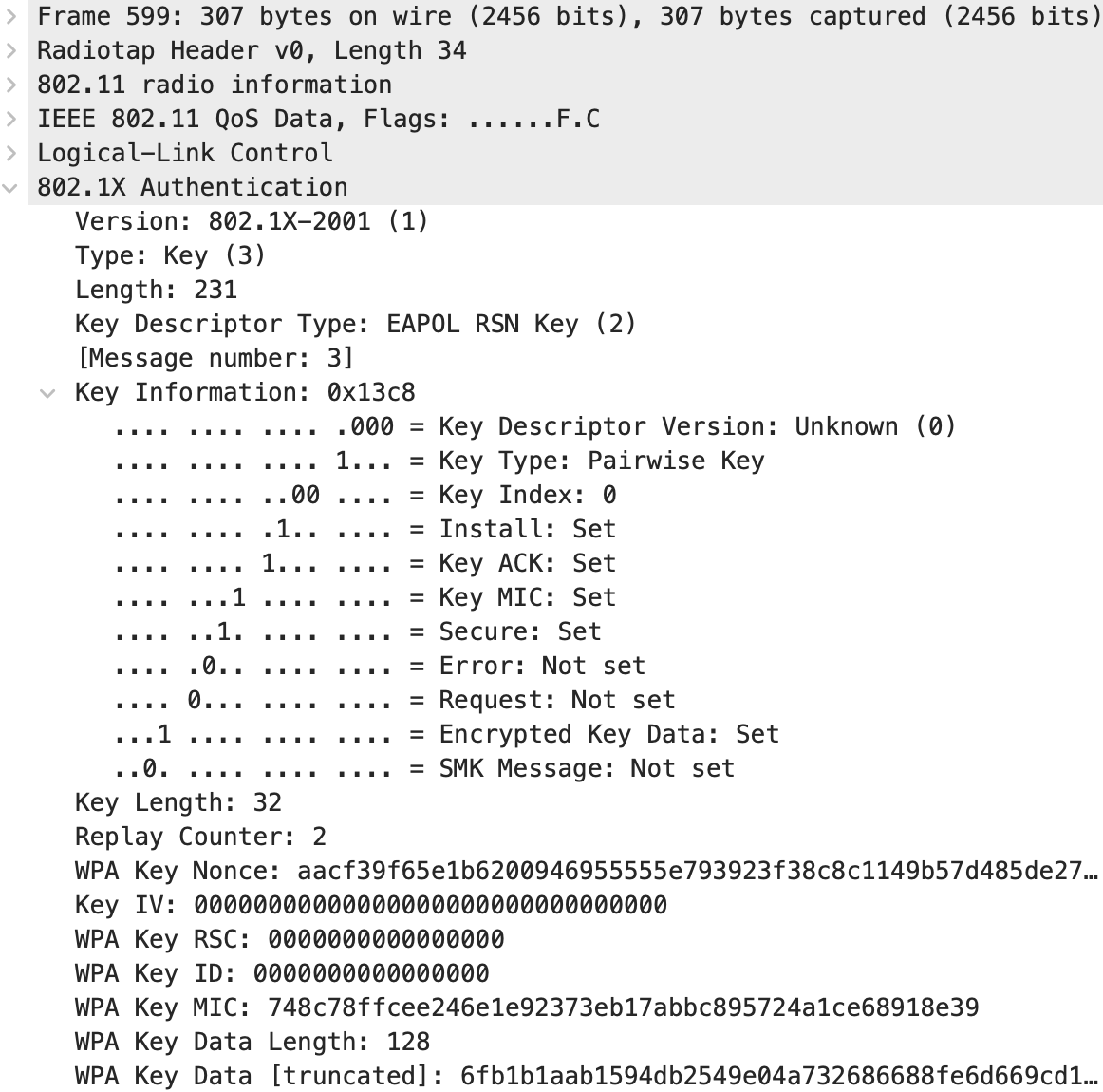
- WPA Key Nonce が Message 1 と同じ ANonce になっている
- Replay Counter が 2 になっている
- Message 1 の値(1)に 1 を足した値(= AP は新しく送るメッセージに、まだ使っていない値を使う)
- ただし 4-Way Handshake での Replay Counter は処理を効率よくするためのもので、リプレイ攻撃は毎回新しい Nonce を使うことで防いでいる(IEEE Std 802.11-2020 12.7.2 NOTE 1)
- Secure が Set になっている
- このメッセージに、STA の初期化に必要な最後の鍵(GTK など)が含まれるため
- Encrypted Key Data が Set になっている
- WPA Key Data フィールドの値が、PTK に含まれる Key Encryption Key(KEK)で暗号化されていることを示している
- Install が Set になっている
- このメッセージを受信した後に PTK をインストールするよう、STA に通知している
Message 3 の各フィールドの値は、規格で次のように定められている(キャプチャの値と一致している)。
Message 3 の各フィールドの値(IEEE Std 802.11-2020, p.2561)
Message 3 uses the following values for each of the EAPOL-Key frame fields:
…
Key Information:
    …
    Install = 0/1 – For PTK generation, 0 only if the AP does not support key mapping keys, or if
        the STA has the No Pairwise bit (in the RSN Capabilities field) equal to 1and only the
        group key is used.
    Key Ack = 1
    Key MIC = 0 when using an AEAD cipher or 1 otherwise
    Secure = 1 (keys installed)
    …
    Encrypted Key Data = 1
    …
Key Length = Cipher-suite dependent; see Table 12-7
Key Replay Counter = n+1
Key Nonce = ANonce – same as message 1
…
なお、Replay Counter フィールドの値がすでに使用されているか、ANonce の値が 1 番目のメッセージ と異なるか、または MIC の検証に失敗した場合、STA はこの 3 番目のメッセージを破棄する。
Message 4
4 番目のメッセージは、3 番目のメッセージに対する応答として STA から AP に送信され、主な目的は STA が PTK や GTK などをインストール済みであることを通知すること。 Message 4 自体に暗号的な役割はなく、Message 3 に対する確認応答である。
Message 4 の役割(IEEE Std 802.11-2020, p.2567)
While message 4 serves no cryptographic purpose, it serves as an acknowledgment to message 3. It is required to inform the Authenticator that the Supplicant has installed the PTK and GTK and hence can receive encrypted frames.
下図は実際に観察できた Message 4。
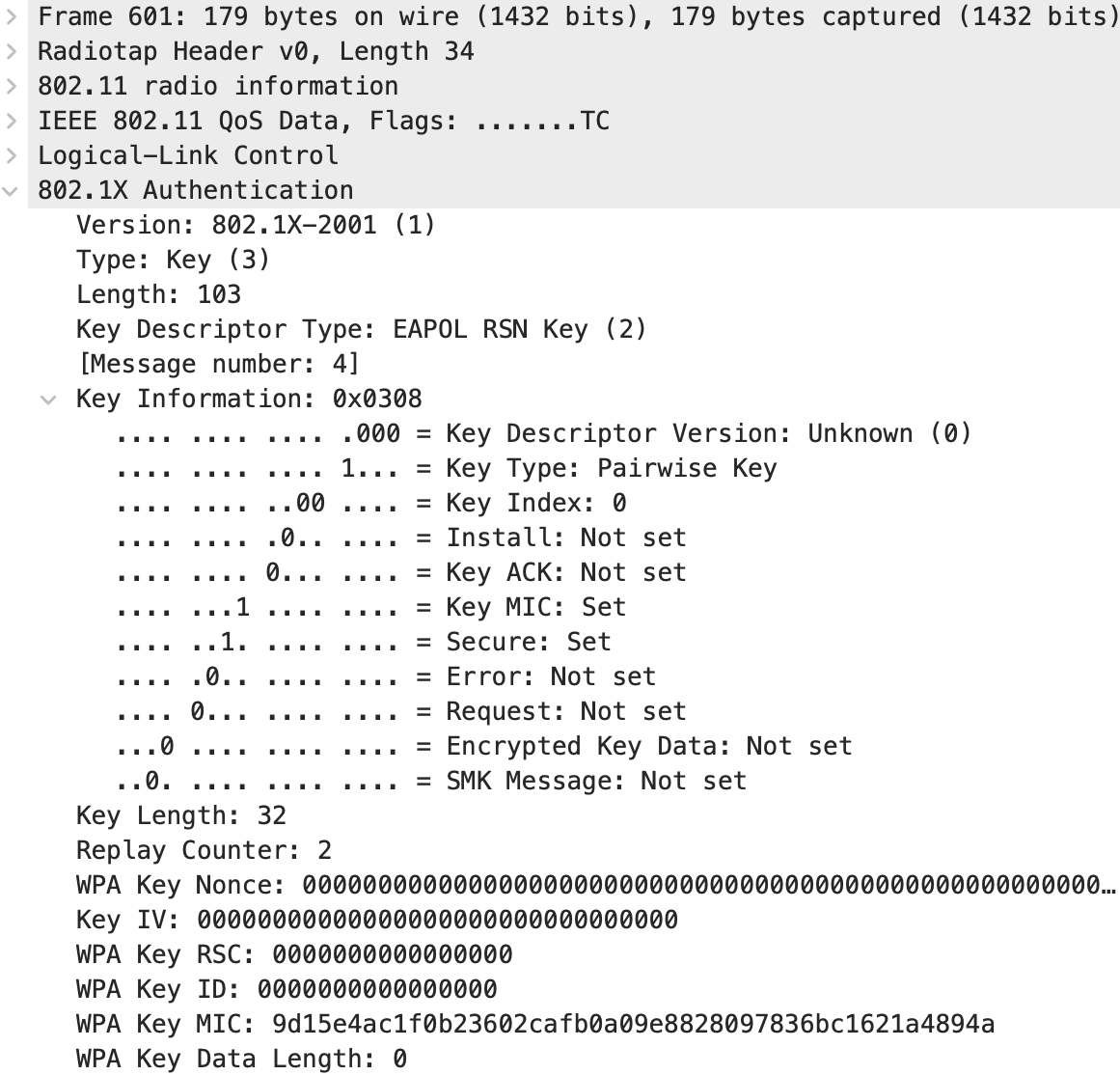
- Replay Counter が Message 3 と同じ 2 になっている
- Key ACK が Not set になっている
- 4-Way Handshake の最後のメッセージなので、AP からの応答は求めない(IEEE Std 802.11-2020 12.7.6.5)
- Secure が Set になっている
- STA が、Secure が 1 の Message 3 を受け取った後のメッセージなので
- Key Length が 32 になっている
- 規格では Message 4 の Key Length は 0 と定められていて(IEEE Std 802.11-2024 でも同じ)、キャプチャの値と異なる
Message 4 の各フィールドの値は、規格で次のように定められている(Key Length 以外はキャプチャの値と一致している)。
Message 4 の各フィールドの値(IEEE Std 802.11-2020, p.2563)
Message 4 uses the following values for each of the EAPOL-Key frame fields:
この 4 番目のメッセージを受信した後、AP は PTK をインストールして、STA と AP の間でやり取りされる Data フレームは PTK および GTK で保護されたものとなり、Wi-Fi 接続が完了した状態(State 4) となる。
PMF が有効な場合
PMF が有効な場合は、STA と AP の間でやり取りされる一部の Management フレームは PTK および IGTK で保護される。
- 保護の対象になるのは robust Management frames と呼ばれるフレームで、Disassociation、Deauthentication、robust Action フレームのこと(IEEE Std 802.11-2020 12.2.7, p.2442)
- ユニキャスト宛のものは、PTK に含まれる TK を使い、ペアワイズ暗号方式(今回は GCMP-256)で保護される(12.2.4, p.2439 / 12.5.5.1, p.2503)
- 保護されたフレームは、Frame Control の Protected Frame が 1 になる(12.2.6, p.2442)
- ブロードキャスト・マルチキャスト宛のものは、IGTK を使い、BIP(今回は BIP-GMAC-256)で保護される(12.2.4, p.2439 / 11.12, p.2228)
- BIP は改ざんの検知とリプレイの防止のための仕組みで、フレームの中身は暗号化されない(12.5.4.1, p.2499)
- WPA3 Specification Version 3.3 では、WPA3-Personal Only Mode・WPA3-Enterprise Only Mode・WPA3-Enterprise 192-bit mode で PMF が必須(PMF Required)
- WPA2 と共存させる Transition Mode では、PMF は使える(PMF Capable)だけで必須ではない(p.9-12)
References
- IEEE 802.11 Working Group (2020), IEEE Standard for Information Technology — Telecommunications and Information Exchange between Systems Local and Metropolitan Area Networks — Specific Requirements Part 11: Wireless LAN Medium Access Control (MAC) and Physical Layer (PHY) Specifications
- IEEE 802.11 Working Group (2021), IEEE Standard for Information Technology — Telecommunications and Information Exchange between Systems Local and Metropolitan Area Networks — Specific Requirements Part 11: Wireless LAN Medium Access Control (MAC) and Physical Layer (PHY) Specifications Amendment 1: Enhancements for High-Efficiency WLAN
- Wi-Fi Alliance, “WPA3 Specification Version 3.3”
- David Westcott, et al. (2011), CWAP: Certified Wireless Analysis Professional Official Study Guide: Exam PW0-270, Wiley
- Tom Carpenter, et al. (2021), Certified Wireless Analysis Professional (CWAP) Official Study Guide (CWAP-404), CertiTrek
- 竹下恵 (2024)、『パケットキャプチャ無線 LAN 編 第 2 版』、リックテレコム